
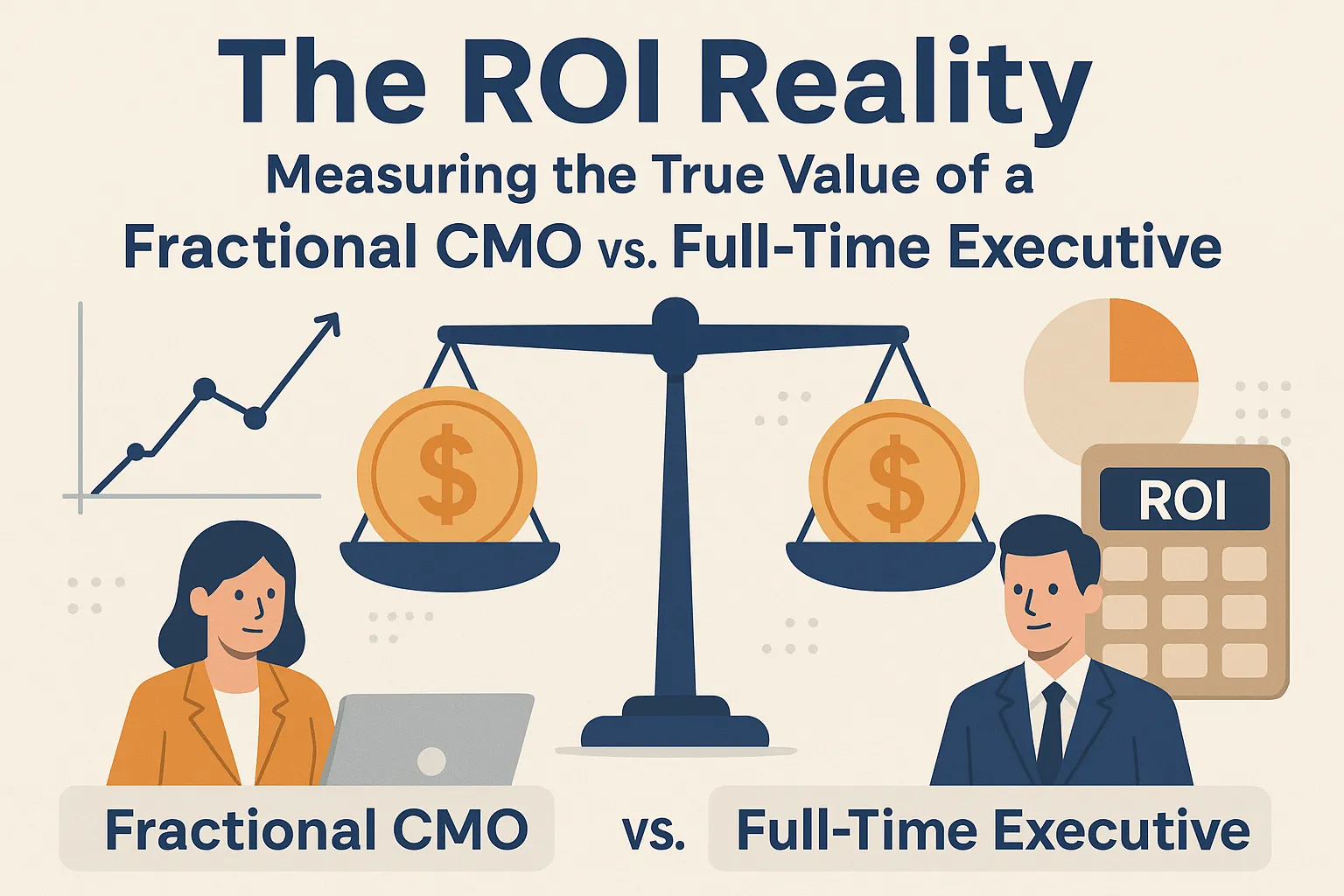
The ROI Reality: Measuring the True Value of a Fractional CMO vs. Full-Time Executive
Understanding the Financial Landscape of Marketing Leadership
When companies reach a certain growth stage, the question of marketing leadership becomes critical. The traditional path has always been clear: hire a full-time Chief Marketing Officer. But the business landscape has evolved dramatically, and with it, the emergence of the fractional CMO model has challenged conventional wisdom about executive hiring.
The financial implications of this choice extend far beyond simple salary comparisons. A full-time CMO in major markets commands anywhere from $200,000 to $500,000 annually, not including benefits, bonuses, and equity packages. This represents a significant commitment for any organization, particularly those in growth phases where capital allocation directly impacts runway and expansion capabilities.
The fractional model presents a fundamentally different value proposition. Rather than bearing the full weight of executive compensation, companies access senior marketing leadership at a fraction of the cost. But the real story isn’t just about cost savings. It’s about understanding when each model delivers optimal value and how to measure that value accurately.
The Hidden Costs of Full-Time Executive Hiring
Bringing on a full-time CMO involves expenses that often catch leadership teams by surprise. The recruitment process alone can consume substantial resources. Executive search firms typically charge 25-35% of the first year’s salary, meaning a $300,000 CMO hire could cost an additional $75,000 to $105,000 just to find the right candidate. This process often stretches three to six months, during which marketing initiatives may stall or drift without strategic direction.
Beyond recruitment lies the onboarding investment. A new full-time executive needs time to understand the company culture, market position, and existing team dynamics. This acclimatization period, often lasting three to six months, represents time when the company is paying full executive compensation without receiving full strategic value. During this phase, marketing momentum can slow as teams adjust to new leadership and direction.
The equity component adds another layer of complexity. Most full-time CMOs expect significant equity packages, diluting existing shareholders and creating long-term financial obligations. Vesting schedules mean companies often find themselves locked into relationships even when strategic needs evolve or performance doesn’t meet expectations.
Calculating the True Investment in Fractional Leadership
The fractional CMO model operates on entirely different economics. These executives typically work on retainer or project basis, dedicating specific hours or days per week to your organization. The immediate cost savings are obvious – you’re paying for perhaps 40-60 hours per month instead of 160-200. But the efficiency gains run deeper than simple hourly mathematics.
Fractional executives bring immediate operational readiness. They’ve navigated similar challenges across multiple organizations and can implement proven strategies without lengthy discovery phases. This compressed timeline means marketing initiatives launch faster, campaigns get to market quicker, and results become measurable sooner.
The flexibility inherent in fractional arrangements provides another form of value. As business needs evolve, the engagement can scale up or down without the complications of employment contracts or severance packages. This agility becomes particularly valuable during uncertain economic conditions or rapid growth phases where needs can shift quarterly.
Measuring Performance Beyond Traditional Metrics
The traditional CMO performance metrics – lead generation, brand awareness, marketing qualified leads – remain relevant regardless of the employment model. However, evaluating ROI requires a more nuanced approach that considers the unique advantages each model brings to these outcomes.
Full-time CMOs often excel at long-term brand building and deep organizational transformation. Their constant presence allows for gradual culture shifts and the patient development of marketing capabilities. They can champion multi-year initiatives and see them through various organizational changes. This continuity proves valuable for companies undertaking fundamental marketing transformations or building category-defining brands.
Fractional CMOs typically deliver faster impact on specific, measurable outcomes. Their external perspective and cross-industry experience often identify quick wins that internal teams miss. They excel at implementing systems and processes that continue delivering value even after their engagement ends. This knowledge transfer represents a form of ROI that traditional metrics often overlook.
Strategic Timing and Business Lifecycle Considerations
The optimal choice between fractional and full-time marketing leadership often depends on where a company sits in its growth journey. Early-stage companies frequently find fractional arrangements ideal. They gain access to senior expertise without depleting precious capital that could fund product development or market expansion. The fractional model allows these companies to punch above their weight class in marketing sophistication.
As organizations scale, the calculation becomes more complex. Companies approaching significant milestones – major funding rounds, IPOs, or aggressive expansion plans – might benefit from the stability and deep integration a full-time CMO provides. The key lies in honest assessment of current needs versus future aspirations.
The fractional model also serves established companies facing specific challenges or transitions. A fractional CMO can guide organizations through digital transformations, market pivots, or merger integrations without the long-term commitment of a full-time hire. This project-based value often delivers exceptional ROI for defined timeframes.
Building Sustainable Marketing Capabilities
One often overlooked aspect of the ROI calculation involves capability building within the existing team. Full-time CMOs, by virtue of their constant presence, might naturally mentor and develop junior team members. However, this assumes they prioritize and excel at team development, which isn’t always the case.
Fractional CMOs, knowing their engagement has defined boundaries, often focus intensively on knowledge transfer and team empowerment. They implement systems, document processes, and train teams to operate independently. This approach creates lasting value that persists beyond the engagement, effectively multiplying the ROI through sustained capability improvement.
The best fractional engagements include specific provisions for team development and knowledge transfer. This might involve regular training sessions, documented playbooks, or structured mentorship programs. When these elements are present, the fractional model can actually outperform full-time arrangements in building organizational marketing muscle.
Making the Right Choice for Your Organization
The decision between a fractional and full-time CMO ultimately depends on a careful analysis of your specific situation. Consider your growth stage, available capital, strategic timeline, and existing team capabilities. Factor in the hidden costs of each model and the different types of value they deliver.
For many organizations, the answer isn’t binary. Some companies successfully employ fractional CMOs during specific growth phases, then transition to full-time leadership when the business reaches appropriate scale. Others maintain fractional relationships indefinitely, finding the flexibility and cost structure align perfectly with their business model.
The key to maximizing ROI lies in clarity about what you need marketing leadership to accomplish. If you need rapid system implementation, specific expertise, or strategic guidance through a defined challenge, the fractional model often delivers superior value. If you’re building a category-defining brand requiring deep, long-term marketing transformation, a full-time executive might prove the better investment.
Remember that both models can deliver exceptional value when properly matched to business needs. The fractional CMO revolution hasn’t replaced traditional executive hiring – it’s expanded the options available to growth-focused companies. By understanding the true ROI implications of each model, leadership teams can make informed decisions that accelerate growth while optimizing resource allocation. The goal isn’t to choose the cheapest option, but rather to select the model that delivers maximum strategic value for your specific situation and growth trajectory.
News editor and RSS curation specialist, 11 years
Daniel spent six years as a digital desk editor at a regional newspaper in Manchester, where he built and maintained more than 400 RSS and API feeds for breaking news coverage. He later worked as a content curation lead for a media monitoring firm, training a team of 14 analysts to filter sources for accuracy and relevance. At LynxFeed he writes about feed readers, news aggregation and practical ways to follow reliable sources without wasting time.
Related posts