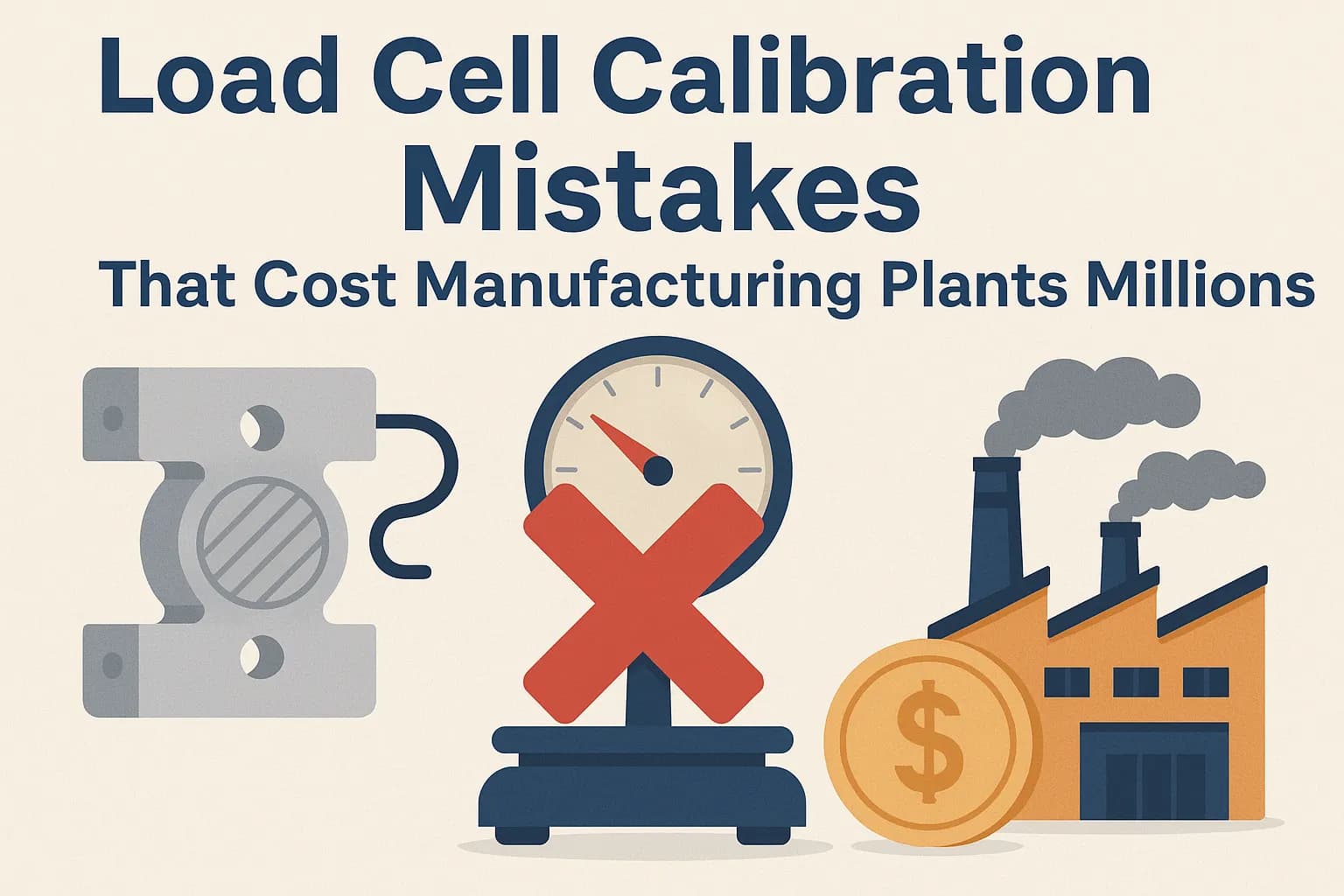
Load Cell Calibration Mistakes That Cost Manufacturing Plants Millions
The Silent Crisis in Manufacturing Precision
In the heart of every manufacturing operation, load cells quietly perform their critical function – measuring force and weight with precision that entire production lines depend upon. Yet beneath this apparent simplicity lies a complex web of calibration requirements that, when neglected or misunderstood, can unleash a cascade of costly consequences.
The financial impact of calibration errors extends far beyond the immediate measurement inaccuracy. When a pharmaceutical company’s load cell drifts out of calibration, entire batches worth millions might require destruction. When an aerospace manufacturer’s force measurement system provides faulty readings, the resulting quality issues can ground fleets and trigger massive recalls. These aren’t theoretical scenarios – they represent real losses that manufacturing plants face when calibration protocols fail.
Understanding the true cost requires looking beyond the obvious. A miscalibrated load cell doesn’t just provide wrong numbers. It undermines quality control systems, corrupts data collection, triggers false alarms, misses critical warnings, and gradually erodes the trust that operators place in their measurement systems. The ripple effects touch everything from raw material usage to customer satisfaction, from regulatory compliance to competitive advantage.
Environmental Factors: The Invisible Calibration Killers
Temperature fluctuations represent perhaps the most underestimated threat to load cell accuracy. Manufacturing environments rarely maintain laboratory-like conditions, yet many calibration procedures ignore the reality of temperature variations. A load cell calibrated in an air-conditioned metrology lab might perform perfectly during verification, only to drift significantly when installed near a furnace or in an unheated warehouse.
The physics behind temperature-induced errors involves multiple mechanisms. The strain gauges themselves change resistance with temperature. The elastic properties of the load cell body shift. Even the adhesives bonding the strain gauges can introduce temperature-dependent effects. Without proper temperature compensation and calibration across the expected operating range, these effects compound into substantial measurement errors.
Humidity presents another often-overlooked challenge. Moisture infiltration can alter the electrical properties of strain gauge installations, create corrosion that changes mechanical properties, and even cause short circuits in extreme cases. Plants operating in coastal areas or those with wash-down requirements face particular risks. Yet many calibration procedures occur in controlled environments that bear no resemblance to actual operating conditions.
The Frequency Dilemma: Over-Calibration vs. Under-Calibration
Determining optimal calibration frequency requires balancing multiple factors, yet many plants rely on arbitrary schedules that ignore actual usage patterns and drift characteristics. Some facilities calibrate religiously every month, incurring unnecessary costs and production disruptions. Others stretch intervals until failures force emergency calibrations, risking quality issues and unplanned downtime.
The financial mathematics of calibration frequency often surprise plant managers. Consider a production line where hourly output value reaches $50,000. A four-hour calibration procedure costs $200,000 in lost production alone, before accounting for technician time and calibration equipment. Yet running with out-of-tolerance load cells might generate quality issues costing far more. Finding the sweet spot requires understanding individual load cell drift patterns and the specific consequences of measurement errors in each application.
Modern approaches employ statistical process control to optimize calibration intervals. By tracking measurement drift over time, plants can predict when calibration becomes necessary rather than following rigid schedules. This predictive approach minimizes both calibration costs and quality risks, yet surprisingly few facilities have implemented such systems.
Documentation Disasters: When Paper Trails Lead Nowhere
Inadequate documentation might seem like a minor administrative issue, but it regularly transforms manageable situations into costly crises. When regulatory auditors arrive, missing calibration records can trigger production shutdowns and hefty fines. When quality issues arise, incomplete documentation prevents root cause analysis and corrective action. When equipment failures occur, poor records leave maintenance teams guessing about historical performance and calibration status.
Effective documentation goes beyond simply recording calibration dates and results. It must capture environmental conditions during calibration, specific procedures followed, equipment used, technician qualifications, and any anomalies observed. This comprehensive record enables trend analysis, supports troubleshooting, and provides the evidence necessary for regulatory compliance.
The transition to digital documentation systems offers tremendous advantages, yet many plants struggle with implementation. Paper records scattered across filing cabinets can’t support the real-time analysis that modern quality systems demand. Digital systems enable automatic alerts when calibrations come due, flag unusual results for investigation, and integrate calibration data with broader quality management systems.
Technical Execution Errors: Where Good Intentions Meet Poor Results
Even well-intentioned calibration efforts can fail due to technical execution errors. Using inappropriate test weights represents a common mistake with serious consequences. Weights that seem adequate might lack proper certification, exhibit wear that compromises accuracy, or simply represent the wrong accuracy class for the application. A one-percent error in test weights translates directly to load cell calibration errors, potentially multiplied across entire measurement ranges.
Loading procedures during calibration require careful attention that hurried technicians often skip. Eccentric loading, where forces apply off-center, can introduce significant errors that don’t appear during centered calibration procedures. Side forces, common in many real-world applications, might go completely untested. Dynamic loading effects, critical in high-speed operations, often receive no consideration during static calibration procedures.
The electrical side of calibration presents its own pitfalls. Grounding issues can introduce noise that masks true load cell response. Cable problems might create intermittent faults that appear and disappear unpredictably. Junction box connections can develop resistance that affects readings. These electrical gremlins often escape detection during routine calibration, only to cause problems during critical production runs.
System Integration Oversights: When Components Don’t Communicate
Modern manufacturing systems rarely use load cells in isolation. They integrate with PLCs, data acquisition systems, and enterprise software. Yet calibration procedures often treat load cells as standalone components, ignoring the system-level effects that can introduce substantial errors.
Signal conditioning equipment between load cells and control systems can introduce its own errors. Analog-to-digital converters might exhibit non-linearity. Amplifiers can drift with temperature or age. Digital filtering might mask important signal components. Without including these elements in calibration procedures, plants create situations where perfect load cells feed corrupted signals into control systems.
Software configuration represents another critical integration point often overlooked during calibration. Scaling factors, unit conversions, and tare adjustments in control system software must align with physical calibration results. Mismatches between software configuration and hardware calibration can create errors that multiply through calculations, potentially affecting entire production batches before detection.
The Human Factor: Training Gaps That Translate to Million-Dollar Mistakes
Behind every calibration error lies a human decision, whether in procedure design, execution, or verification. Yet many plants underinvest in calibration training, treating it as a simple task that any technician can perform. This attitude ignores the complexity of modern load cell systems and the sophisticated understanding required for proper calibration.
Effective calibration requires understanding measurement uncertainty, statistical analysis, and metrology principles that go beyond basic technical training. Technicians must recognize when results indicate problems beyond simple adjustment. They need to understand how different error sources combine and propagate through measurement systems. This knowledge gap often leads to situations where technicians conscientiously follow procedures that fundamentally misunderstand calibration requirements.
The cultural aspects of calibration prove equally important. When production pressure mounts, calibration often gets deferred or rushed. When technicians raise concerns about questionable results, production demands might override their cautions. Creating a culture that values measurement integrity requires leadership commitment that goes beyond written procedures to actual daily priorities.
Transforming Calibration from Cost Center to Value Driver
Progressive manufacturers increasingly recognize calibration as an investment in quality and efficiency rather than a necessary evil. By implementing comprehensive calibration programs that address environmental factors, optimize frequencies, ensure thorough documentation, eliminate technical errors, consider system integration, and invest in human expertise, plants can transform their measurement systems from liability to competitive advantage.
The financial returns from proper calibration extend beyond avoiding million-dollar mistakes. Accurate load cells enable tighter process control, reducing material waste and improving product consistency. They support predictive maintenance programs that prevent costly failures. They provide the data foundation for continuous improvement initiatives that drive long-term competitiveness.
The path forward requires recognizing that load cell calibration represents a critical business process deserving the same attention as production planning or quality control. It demands investment in proper equipment, comprehensive procedures, ongoing training, and cultural commitment. Yet for plants willing to make this investment, the returns – in avoided losses, improved quality, and enhanced capability – far exceed the costs. In an increasingly competitive manufacturing landscape, the precision that proper calibration enables might well determine which plants thrive and which struggle to survive.
News editor and RSS curation specialist, 11 years
Daniel spent six years as a digital desk editor at a regional newspaper in Manchester, where he built and maintained more than 400 RSS and API feeds for breaking news coverage. He later worked as a content curation lead for a media monitoring firm, training a team of 14 analysts to filter sources for accuracy and relevance. At LynxFeed he writes about feed readers, news aggregation and practical ways to follow reliable sources without wasting time.